
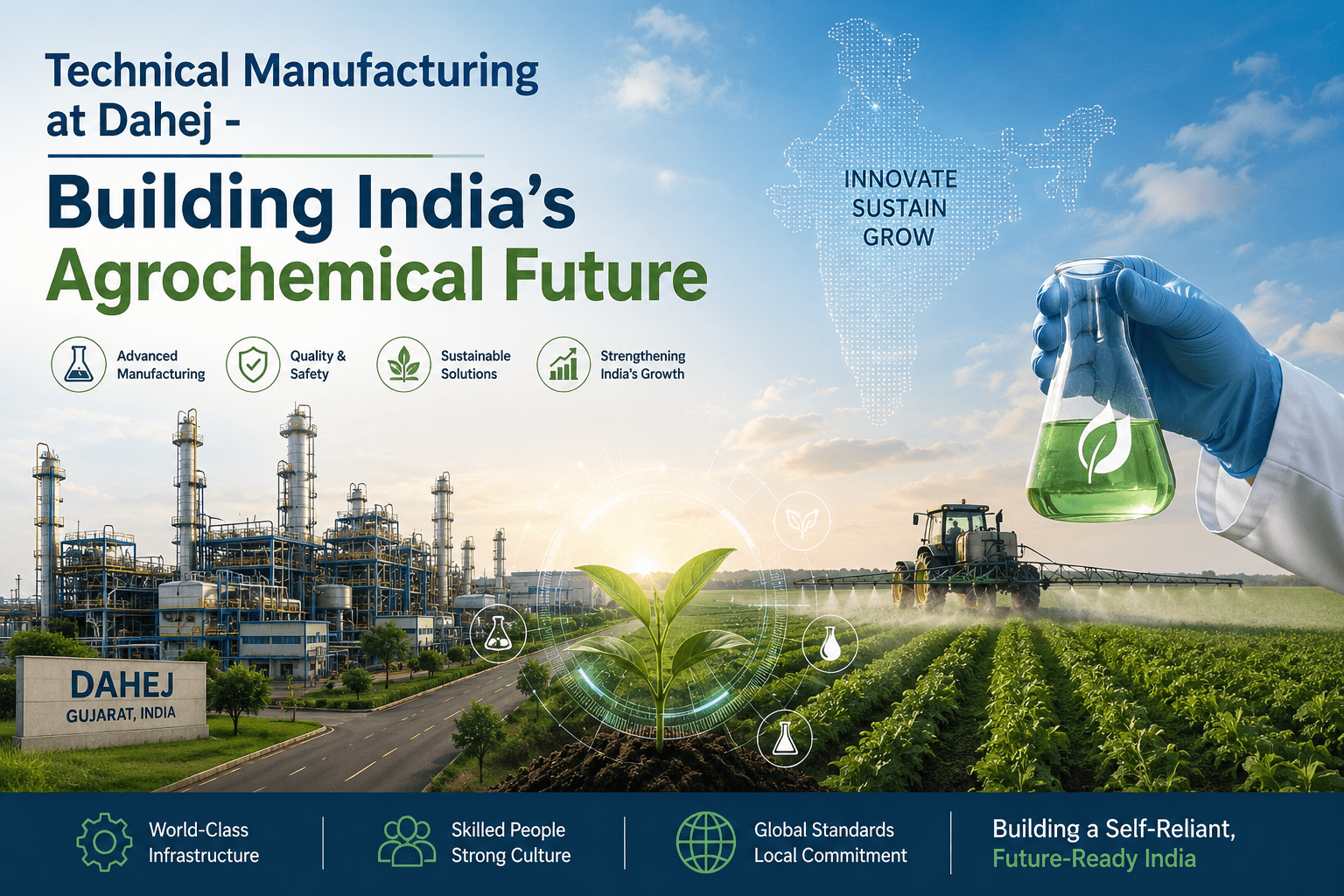
Introduction: Gujarat at the Heart of India's Agrochemical Growth
India's agrochemical industry has emerged as one of the most dynamic sectors in global agriculture, contributing significantly to food security, crop productivity, and export revenue. At the forefront of this transformation stands Gujarat - a state that has consistently positioned itself as the preferred destination for agrochemical manufacturing excellence. With world-class infrastructure, investor-friendly policies, and a skilled industrial workforce, Gujarat has attracted leading manufacturers to establish large-scale production facilities that cater to both domestic and international demand.
Among the most strategically important industrial zones in Gujarat, the Dahej Petroleum, Chemicals and Petrochemicals Investment Region (PCPIR) has become a global benchmark for large-scale chemical manufacturing. Ratnakar India Ltd, a trusted agrochemical manufacturer Gujarat, has established its technical manufacturing facility in this premier industrial hub, leveraging the zone's exceptional infrastructure to produce high-purity active ingredients at scale. This facility represents the company's long-term commitment to backward integration, quality excellence, and global competitiveness in the crop protection industry.
Why Dahej? The Strategic Advantage of India's Premier Industrial Hub
The choice of Dahej as the manufacturing base is deeply strategic. Located on the southern coast of Gujarat with direct access to the Gulf of Khambhat, Dahej offers unparalleled logistical advantages for a company that serves global markets. The dedicated chemical zone ensures regulatory clarity, reliable utility infrastructure including power, water, and effluent treatment, and proximity to a network of raw material suppliers and downstream formulators.
For pesticide exporters from India, the port connectivity at Dahej provides a significant competitive edge - enabling faster, cost-efficient shipment of bulk technical molecules to customers across Asia, Africa, Europe, Latin America, and the Middle East. The proximity to Hazira port and access to major national highways further reduce logistics costs and lead times, ensuring that Ratnakar India can fulfil large international orders with reliability and speed.
Beyond logistics, Dahej's PCPIR status means the facility benefits from streamlined environmental clearances, dedicated effluent treatment infrastructure, and access to a skilled chemical engineering workforce. These factors collectively allow Ratnakar India to maintain consistent production schedules, uphold safety standards, and scale operations in response to growing global demand for high-quality technical-grade agrochemicals.
Technical Manufacturing: The Foundation of Superior Crop Protection
Technical manufacturing is the cornerstone of any world-class crop protection products manufacturer. Unlike formulation, where active ingredients are blended with carriers and adjuvants to create end-use products, technical manufacturing involves the synthesis and purification of the active ingredient itself - the molecule that delivers the pesticidal effect. The purity, stability, and consistent quality of the technical grade material directly determines the efficacy and safety of every formulated product downstream.
At the Dahej facility, Ratnakar India produces a comprehensive portfolio of technical-grade molecules spanning insecticides, herbicides, fungicides, and plant growth regulators. Each molecule is synthesised through carefully optimised chemical processes, then rigorously purified and tested to meet international purity specifications. The result is a range of technical actives that satisfy the stringent quality requirements of global regulatory bodies, including those of the European Union, United States EPA, and various Asian markets.
As a leading insecticide manufacturer & supplier, Ratnakar India produces key synthetic molecules including Acetamiprid, Chlorantraniliprole, Thiamethoxam, Lambda Cyhalothrin, Deltamethrin, Bifenthrin, Cypermethrin, and Dinotefuran - all of which are critical active ingredients used across a wide range of insecticide formulations globally. The herbicide portfolio includes Glyphosate and Metribuzin, while the fungicide range features Azoxystrobin, Tebuconazole, and Tricyclazole. This breadth of production capability makes Ratnakar India a one-stop technical source for formulators across the globe.
Backward Integration: Controlling Quality from Source to Solution
One of the most significant advantages of owning a dedicated technical manufacturing facility is the ability to exercise complete quality control through backward integration. For an agrochemical formulation company like Ratnakar India, producing its own technical actives means that the quality of raw material entering the formulation process is fully known, controlled, and documented - eliminating the uncertainty that comes with third-party sourcing.
Backward integration also delivers substantial cost efficiencies. By removing intermediaries from the supply chain, Ratnakar India can produce formulations at more competitive prices without compromising on quality. This is a critical advantage in serving markets where price sensitivity is high and where customers expect both affordability and consistent performance. The savings generated through backward integration are reinvested into R&D, quality systems, and capacity expansion - creating a virtuous cycle of improvement and growth.
Furthermore, owning the entire value chain from technical synthesis to finished formulation allows Ratnakar India to respond faster to supply disruptions, raw material price fluctuations, and sudden increases in market demand. As a reliable technical grade pesticide supplier, this resilience is valued enormously by international buyers who depend on consistent supply schedules for their own production planning and farmer commitments.
State-of-the-Art Manufacturing Infrastructure and Technology
The Dahej facility is equipped with modern chemical synthesis reactors, distillation and crystallisation units, advanced filtration systems, and precision analytical laboratories. Continuous process monitoring using digital control systems ensures that every batch meets predefined quality specifications, with real-time data tracking providing full traceability from raw material intake to finished technical output.
The facility's analytical laboratory is equipped with HPLC, GC-MS, and other sophisticated instruments capable of determining active ingredient purity, identifying impurity profiles, and confirming compliance with international pharmacopoeial and pesticide standards. This in-house analytical capability eliminates dependence on external testing, accelerates batch release timelines, and provides immediate feedback for process optimisation.
Environmental sustainability is embedded into the facility design. The Dahej plant is equipped with a state-of-the-art effluent treatment plant (ETP), solvent recovery systems, and emission control infrastructure that ensures all outputs comply with the Gujarat Pollution Control Board (GPCB) norms and international environmental standards. As a responsible bulk pesticide supplier Gujarat, Ratnakar India recognises that sustainable manufacturing is not just a regulatory requirement - it is a long-term business imperative.
Quality Assurance: Meeting Global Regulatory Standards
Every technical molecule produced at the Dahej facility undergoes a multi-stage quality assurance process. Starting from incoming raw material inspection, through in-process quality checks at each synthesis stage, to final product testing against internationally recognised specifications, the quality management system ensures zero-compromise on product integrity.
Ratnakar India's quality systems are aligned with ISO standards and Good Manufacturing Practice (GMP) guidelines. The company maintains detailed batch records, stability data, and analytical certificates of analysis (CoA) for every product, providing customers with complete transparency and traceability. For international buyers, this documentation is essential for regulatory submissions in their respective markets and for demonstrating compliance with importing country requirements.
The technical team at Dahej continuously monitors global regulatory developments - including updates to FAO/WHO specifications, European Commission directives, and US EPA tolerance levels - to ensure that production specifications remain current and that customers can rely on Ratnakar India as a long-term, compliant technical grade pesticide supplier in an ever-evolving regulatory environment.
Scalability and Capacity: Meeting Global Demand at Scale
One of the defining capabilities of the Dahej facility is its ability to scale production rapidly in response to market demand. With large-reactor capacities and modular production infrastructure, Ratnakar India can increase output of specific molecules during peak demand seasons without compromising on quality or delivery timelines. This scalability is a critical differentiator for buyers who need large, reliable volumes - particularly for crop protection programs covering millions of acres.
As one of the leading bulk pesticide suppliers Gujarat, Ratnakar India regularly fulfils bulk orders for technical actives ranging from several hundred kilograms to multi-tonne consignments. The company's production planning team works closely with customers to align manufacturing schedules with buyer delivery requirements, ensuring seamless supply even during high-demand agricultural seasons. This customer-centric approach to production planning builds long-term relationships based on trust, reliability, and mutual growth.
Research and Development: Driving Innovation in Technical Manufacturing
Technical manufacturing excellence is not achieved through production capacity alone - it requires continuous investment in research and development. At Ratnakar India, the R&D team at Dahej works on process chemistry innovation, yield improvement, impurity reduction, and the development of greener synthesis pathways that reduce environmental footprint without compromising product quality.
The R&D program also focuses on developing new technical molecules that address emerging pest resistance challenges and expanding the company's active ingredient portfolio to serve the evolving needs of global agriculture. Collaboration with leading academic institutions and research organisations in India and abroad strengthens the innovation pipeline, ensuring that Ratnakar India remains at the technology frontier of the crop protection products manufacturer landscape.
Conclusion: Dahej as the Engine of Ratnakar India's Global Ambitions
The technical manufacturing facility at Dahej is far more than a production site - it is the strategic engine that powers Ratnakar India's ambitions as a globally respected agrochemical company. By combining world-class infrastructure, advanced technology, rigorous quality systems, and a deeply experienced technical team, the facility enables Ratnakar India to deliver technical-grade agrochemicals that meet the highest international standards.
As India's agrochemical sector continues its growth trajectory, and as global demand for reliable, high-quality crop protection solutions intensifies, the Dahej facility positions Ratnakar India as a partner of choice for formulators, distributors, and agricultural companies worldwide. The company's commitment to manufacturing excellence, sustainability, and innovation ensures that the Dahej facility will remain a cornerstone of India's agrochemical industry for decades to come.
- Advanced infrastructure at Dahej ensures large-scale production of high-purity technical pesticides, supporting global demand and reinforcing Ratnakar India's reputation as a premier agrochemical manufacturer Gujarat.
- Comprehensive technical portfolio spanning insecticides, herbicides, fungicides, and PGRs - including Chlorantraniliprole, Thiamethoxam, Azoxystrobin, Glyphosate, and Tebuconazole - enables serving diverse agricultural markets globally.
- Backward integration from raw material to finished formulation ensures consistent quality, cost efficiency, and supply reliability, making Ratnakar India a trusted partner among pesticide exporters from India.
- Modern analytical laboratories equipped with HPLC and GC-MS instruments provide rigorous quality verification, ensuring all technical actives meet international regulatory specifications.
- ISO-aligned quality management systems with full batch traceability, CoA documentation, and GMP compliance support international customers' regulatory requirements across global markets.
- Scalable high-capacity production enables bulk supply to global buyers, establishing Ratnakar India as a dependable bulk pesticide supplier Gujarat for large-volume international contracts.
- Continuous R&D investment drives process innovation, yield improvement, and new molecule development, keeping Ratnakar India at the cutting edge of crop protection products manufacturer capabilities.
- Strategic location in Dahej PCPIR provides direct port access, reducing logistics costs and enabling timely delivery of bulk technical exports to global markets.
- Integrated manufacturing and formulation under one company roof enables complete agrochemical solutions, positioning Ratnakar India as a comprehensive agrochemical formulation company for international clients.
- Environmental compliance through advanced ETP and emission control systems ensures sustainable operations aligned with GPCB norms and international environmental standards.
Technical Manufacturing Portfolio - Dahej Facility
The following table lists the key technical-grade molecules manufactured at Ratnakar India's Dahej production facility, available for bulk supply to formulators and institutional buyers across India and global markets.
| Sr. No. | Technical Active Ingredient |
|---|---|
| 1 | Acetamiprid Technical |
| 2 | Alphamethrin Technical |
| 3 | Azoxystrobin Technical |
| 4 | Bifenthrin Technical |
| 5 | Chlorantraniliprole Technical |
| 6 | Cypermethrin Technical |
| 7 | Deltamethrin Technical |
| 8 | Diafenthiuron Technical |
| 9 | Dinotefuran Technical |
| 10 | Fenoxaprop-P-Ethyl Technical |
| 11 | Glyphosate Technical |
| 12 | Lambda Cyhalothrin Technical |
| 13 | Lufenuron Technical |
| 14 | Metribuzin Technical |
| 15 | Paclobutrazole Technical |
| 16 | Pyriproxyfen Technical |
| 17 | Pymetrozine Technical |
| 18 | Tebuconazole Technical |
| 19 | Thiamethoxam Technical |
| 20 | Thifluzamide Technical |
| 21 | Tricyclazole Technical |