
Why Gujarat Leads India's Agrochemical Industry
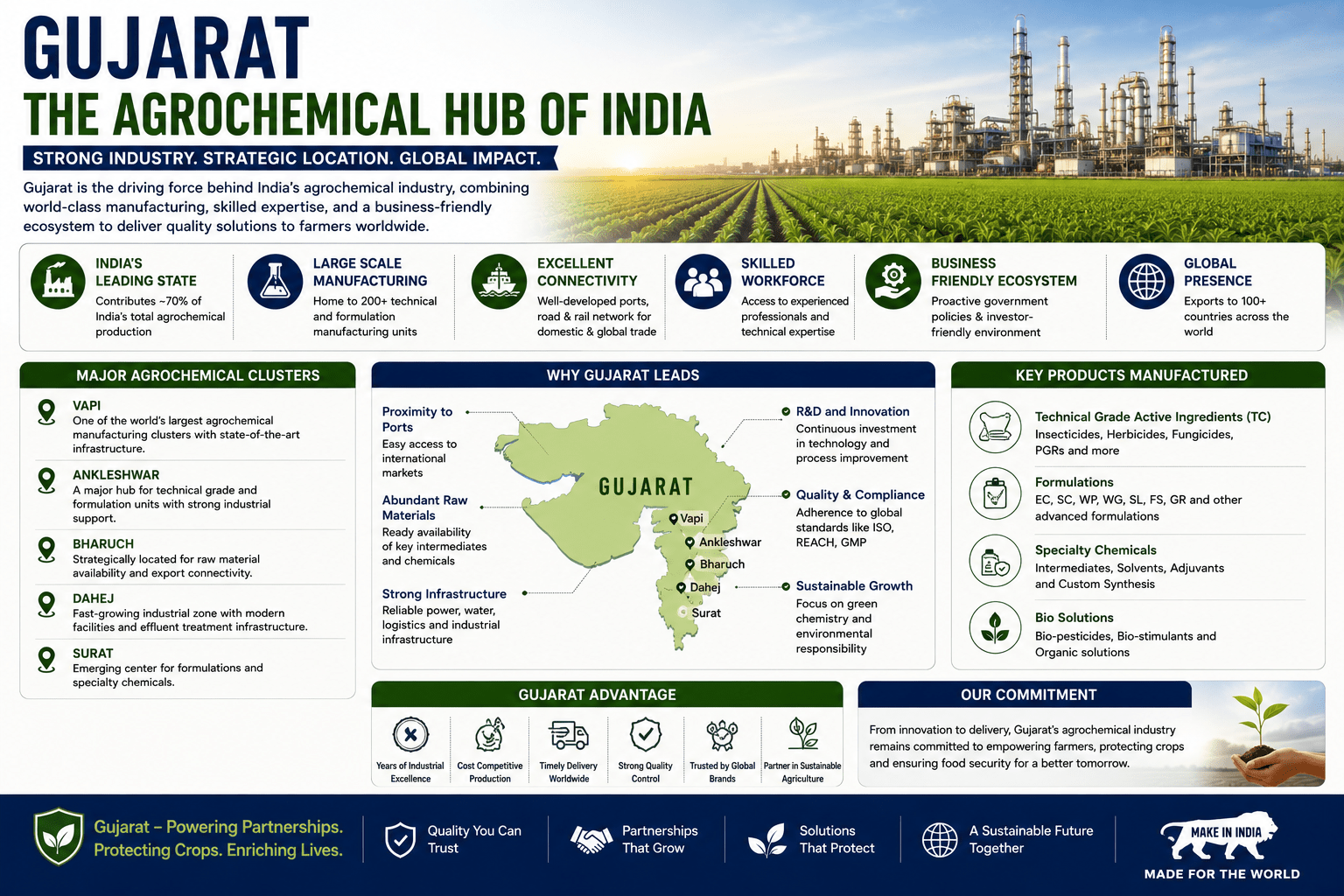
Gujarat's dominance in India's agrochemical industry is the result of decades of deliberate industrial policy, infrastructure investment, and entrepreneurial excellence that have created an unmatched ecosystem for chemical manufacturing. The state accounts for approximately 60-70% of India's total agrochemical production - an extraordinary concentration that reflects the genuine structural advantages Gujarat offers to manufacturers. From the PCPIR at Dahej to the GIDC industrial estates spread across the state, Gujarat provides the infrastructure, regulatory environment, and human capital that make it the natural home for any serious agrochemical manufacturer Gujarat with national or global ambitions.
Industrial Infrastructure: World-Class Zones
Gujarat's chemical manufacturing zones are among the most sophisticated in Asia. The Dahej PCPIR - a 453 sq. km investment region dedicated to petroleum, chemicals, and petrochemicals - provides manufacturing companies with dedicated infrastructure including industrial-grade power supply, pipeline networks for raw materials and utilities, centralised effluent treatment, and a regulatory framework that streamlines environmental clearances and industrial licensing. GIDC estates across the state provide additional industrial plot options with varying utility configurations suited to different scales and types of manufacturing operations. For a company like Ratnakar India, access to this world-class infrastructure enables the kind of large-scale, technically sophisticated manufacturing that international markets demand.
Port Connectivity: Gateway to Global Markets
One of Gujarat's most significant advantages for agrochemical manufacturers is its exceptional port connectivity. The state has the longest coastline of any Indian state - over 1,600 km - with multiple major ports including Mundra (India's largest private port), Kandla, Hazira, and Dahej providing direct access to global shipping routes. For pesticide exporters from India, this port infrastructure dramatically reduces the time and cost of reaching international markets compared to manufacturers located in landlocked states. Container shipping services from Gujarat's ports connect to major markets in Southeast Asia, Africa, the Middle East, Europe, and the Americas, enabling competitive export logistics that support India's global agrochemical supply leadership.
Human Capital: Chemical Engineering Excellence
Gujarat's industrial history has created a deep talent pool of chemical engineers, process chemists, quality professionals, and regulatory experts that few other states can match. Major technical universities and engineering colleges in Ahmedabad, Baroda, Surat, and other cities consistently produce graduates with strong chemical engineering foundations suited to agrochemical manufacturing careers. This availability of skilled, experienced technical talent enables manufacturers to build and maintain the expert teams needed for sophisticated chemical synthesis, formulation development, quality assurance, and regulatory compliance. For Ratnakar India's technical manufacturing operations, access to Gujarat's chemical engineering talent pool is a critical operational advantage as a crop protection products manufacturer.
Policy Environment: Supporting Industrial Growth
Gujarat's state government has consistently maintained a pro-business policy environment that supports industrial investment. Streamlined land acquisition and industrial licensing processes, single-window clearance for new investments, competitive power tariffs, infrastructure development responsive to industry needs, and stable long-term industrial policy - these elements of Gujarat's governance environment reduce the cost and uncertainty of establishing and expanding manufacturing operations. For agrochemical companies considering capacity expansion, Gujarat's policy environment makes investment decision-making more straightforward and investment returns more predictable, reinforcing the state's position as India's premier agrochemical formulation company destination.
The Future: Gujarat's Agrochemical Leadership Continues
Gujarat's position as India's agrochemical hub is not merely a historical legacy - it is an actively strengthening competitive position. New investment in the state's chemical zones, expansion of port capacity, upgrading of industrial infrastructure, and continued development of technical education are all reinforcing Gujarat's structural advantages. As the global demand for agrochemicals continues to grow, driven by expanding agricultural production needs and increasing emphasis on food security, Gujarat's manufacturers - including Ratnakar India - are well-positioned to capture this growing demand and further strengthen India's global agrochemical supply leadership.
- Gujarat accounts for 60-70% of India's total agrochemical production - an unmatched concentration reflecting genuine structural advantages.
- World-class industrial zones like Dahej PCPIR provide dedicated infrastructure, utilities, and regulatory support for chemical manufacturing.
- Gujarat's 1,600+ km coastline and multiple major ports enable competitive export logistics to global markets.
- Deep talent pool of chemical engineers from leading technical universities supports sophisticated manufacturing operations.
- Pro-business policy environment with streamlined processes reduces investment cost and uncertainty for manufacturers.
- Continued infrastructure investment and capacity expansion reinforce Gujarat's position as India's premier agrochemical hub.