
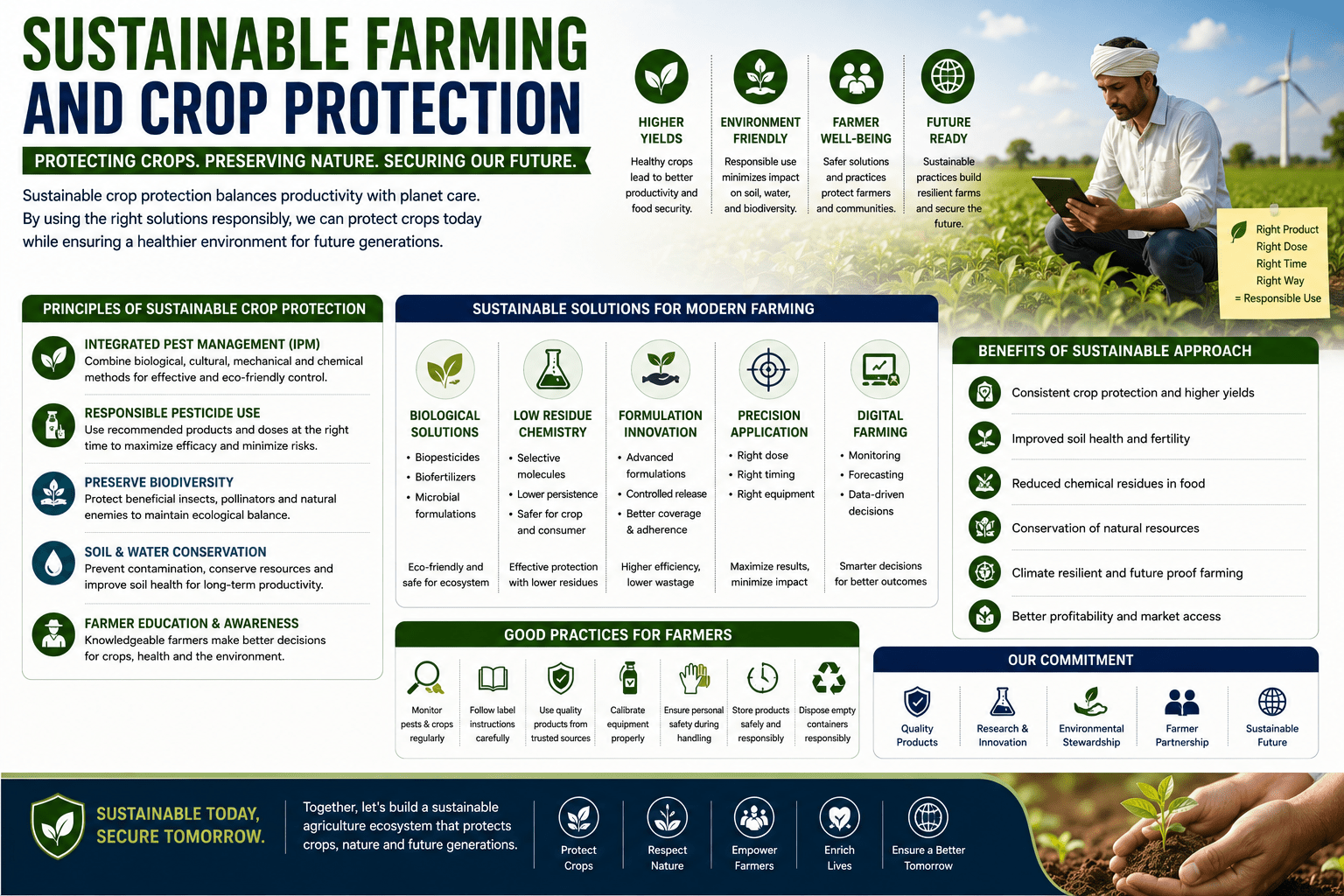
Reframing the Relationship Between Agrochemicals and Sustainability
A common misconception positions agrochemicals and sustainability as inherently in conflict - that chemical crop protection is inherently unsustainable and must be replaced by purely biological or organic approaches. The reality is more nuanced and more hopeful. Modern, responsibly used agrochemicals - when integrated into sophisticated Integrated Pest Management (IPM) programs - are essential tools for achieving the sustainable intensification that feeding a growing global population on a finite agricultural land base requires. The goal is not to eliminate chemical crop protection, but to use it selectively, responsibly, and as part of a comprehensive system that minimises environmental impact while maintaining the pest control efficacy that productive farming depends on. Every responsible agrochemical manufacturer Gujarat like Ratnakar India understands this sustainability imperative.
Integrated Pest Management: Chemistry in Its Proper Role
Integrated Pest Management places chemical control in its proper role - as one tool among many, deployed only when pest populations exceed economic threshold levels, in combination with preventive cultural practices, biological controls, resistant varieties, and physical management methods. Under IPM, insecticides are not applied on a calendar-based schedule regardless of actual pest pressure - they are applied when monitoring shows that pest populations have reached the level at which the economic value of yield protection justifies the cost and environmental impact of control. This threshold-based approach typically reduces the number of chemical applications by 30-50% compared to calendar-based spraying, while maintaining equivalent or better crop protection outcomes. Ratnakar India supports IPM through farmer education programs and the development of crop protection products with modes of action compatible with beneficial insect preservation.
Modern Chemistry: Lower Doses, Higher Selectivity
Modern agrochemical research has produced a new generation of highly selective, low-dose active ingredients that deliver exceptional pest control while minimising impact on non-target organisms. Chlorantraniliprole (in Ratnakar India's SHOLEY range) acts specifically on insect ryanodine receptors, providing exceptional control of caterpillar pests at application rates 10-50 times lower than older chemistry, with high selectivity for insects versus mammals and beneficial invertebrates. Spinosad (in Gracer and RATNA SPINORIL) is derived from natural fermentation and provides highly selective insect control compatible with IPM programs. These innovations by insecticide manufacturers & suppliers represent genuine progress in the sustainability of chemical crop protection.
Resistance Management: Protecting Chemistry for Future Generations
Responsible use of crop protection chemistry requires attention to resistance management - ensuring that the chemistries available today remain effective for farmers of the future. Resistance develops when pest populations are repeatedly exposed to the same active ingredient or mode of action, creating selection pressure that favours resistant individuals. Responsible manufacturers like Ratnakar India actively promote resistance management through diverse product portfolios spanning multiple chemical classes, product labelling that recommends rotation strategies, and education programs that help farmers and distributors understand and implement effective resistance management practices. This stewardship responsibility is inseparable from the mission of a sustainable agrochemical formulation company.
Environmental Stewardship in Manufacturing
Sustainability in agrochemicals extends beyond how products are used on farms - it encompasses how they are manufactured. Ratnakar India's commitment to environmental stewardship in manufacturing includes investment in effluent treatment infrastructure, solvent recovery systems, energy efficiency programs, and compliance with all applicable environmental regulations. The company's Dahej facility operates with environmental management systems aligned with regulatory requirements and progressively improving environmental performance indicators. This manufacturing sustainability is inseparable from the broader mission of being a responsible participant in India's agricultural ecosystem as a long-term agrochemical manufacturer Gujarat.
- Modern crop protection, used responsibly in IPM programs, is essential for sustainable intensification of global food production.
- IPM reduces chemical applications 30-50% through threshold-based use while maintaining equivalent crop protection outcomes.
- New-generation selective chemistry like Chlorantraniliprole and Spinosad provides exceptional pest control at lower doses with reduced non-target impact.
- Resistance management through chemical class rotation protects long-term efficacy of available chemistry for future farmers.
- Manufacturing environmental stewardship - ETP, solvent recovery, energy efficiency - is integral to sustainable agrochemical operations.
- Farmer education on responsible agrochemical use is a core responsibility of manufacturers committed to sustainable agriculture.