
India's Pesticide Export: An Overview
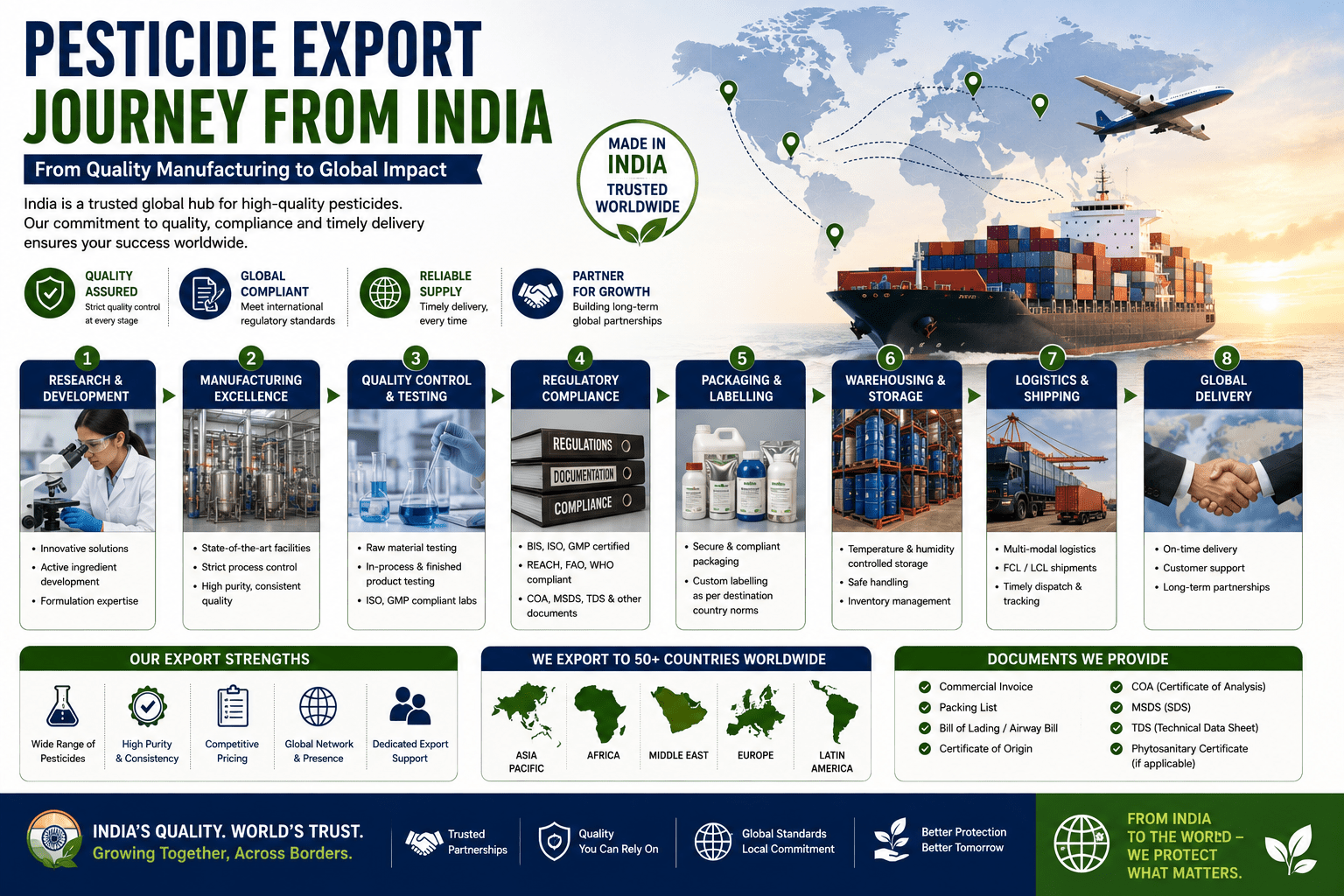
India's pesticide export industry has grown into a significant global force, with annual exports worth several billion dollars reaching markets across all inhabited continents. The journey from a manufacturing facility in Gujarat to a farmer's field in Kenya, Vietnam, or Brazil involves a complex sequence of manufacturing, quality verification, regulatory compliance, logistics, and market development activities. Understanding this journey helps buyers appreciate the value and complexity embedded in every consignment of Indian-manufactured pesticides, and why reliable pesticide exporters from India like Ratnakar India represent a significant investment in systems, expertise, and relationships.
Step 1: Manufacturing Excellence
The export journey begins in the manufacturing facility, where technical actives are synthesised or formulated products are produced. At Ratnakar India's facilities - including the Dahej technical manufacturing plant and formulation units - every production batch follows validated manufacturing procedures with real-time process monitoring and control. Experienced production chemists and technicians ensure that each batch meets the defined specifications for active ingredient content, physical properties, and stability. The quality of this manufacturing step is the foundation on which everything else in the export journey rests. An agrochemical manufacturer Gujarat that compromises on manufacturing quality cannot compensate downstream.
Step 2: Quality Testing and Certification
Before any product can be dispatched for export, it must pass comprehensive quality testing in Ratnakar India's analytical laboratory. Active ingredient content is verified by HPLC or GC analysis against validated reference standards. Physical properties - pH, density, viscosity, particle size for suspensions - are measured and confirmed against specification. Stability data is reviewed to ensure the product will maintain quality throughout its expected shelf life in the destination market's storage conditions. The passing Certificate of Analysis that accompanies each export consignment is not simply a piece of paper - it is the documented proof of quality that protects both the exporter's reputation and the importer's interests as a credible agrochemical formulation company.
Step 3: Regulatory and Documentation Compliance
Every export consignment must be accompanied by a comprehensive set of documents - export licence (where required), phytosanitary certificates (for biological products), bill of lading, commercial invoice, packing list, certificate of origin, and Material Safety Data Sheet. For imports into regulated markets, additional documentation may be required - registration certificates valid in the destination country, analytical methods for residue testing, or specific labelling requirements. Ratnakar India's regulatory and export documentation team manages this complexity, ensuring complete, accurate documentation that facilitates smooth customs clearance in destination markets. This documentation expertise is a critical capability for any professional bulk pesticide supplier Gujarat with serious export ambitions.
Step 4: Packaging and Export Logistics
Pesticide products must be packaged appropriately for the rigours of international transport - capable of withstanding handling, temperature variations, and extended storage while maintaining product integrity and preventing leakage or contamination. Export packaging must comply with UN Dangerous Goods regulations for hazardous chemical transport by sea or air, including proper hazard labelling, UN approval markings, and segregation requirements. Gujarat's port infrastructure - particularly Dahej and Mundra ports - provides Ratnakar India with efficient access to global shipping routes, enabling competitive freight costs and reasonable transit times to export markets, reinforcing its position as a reliable insecticide manufacturer & supplier for global buyers.
Step 5: Market Development and Customer Support
The export journey does not end at the port. Sustainable export success requires ongoing market development investment - supporting product registration in new markets, building relationships with in-country distributors, providing technical support to end users, and maintaining dialogue with buyers on performance feedback and product improvement. Ratnakar India invests in these market development activities as integral to its long-term export strategy - understanding that each market requires sustained attention and investment to realise its potential for Indian agrochemical exports.
- Manufacturing excellence - validated processes, real-time monitoring - is the irreplaceable foundation of every export journey.
- Comprehensive quality testing and CoA documentation provide the quality proof required by international buyers globally.
- Complete, accurate export documentation ensures smooth customs clearance and regulatory compliance in destination markets.
- UN-compliant hazardous goods packaging and Gujarat port access ensure safe, efficient international product delivery.
- Market development investment - registrations, distributor relationships, technical support - sustains long-term export success.
- The full export journey from factory to farmer requires investment in systems, expertise, and relationships across multiple disciplines.