
Understanding Technical Grade Pesticides
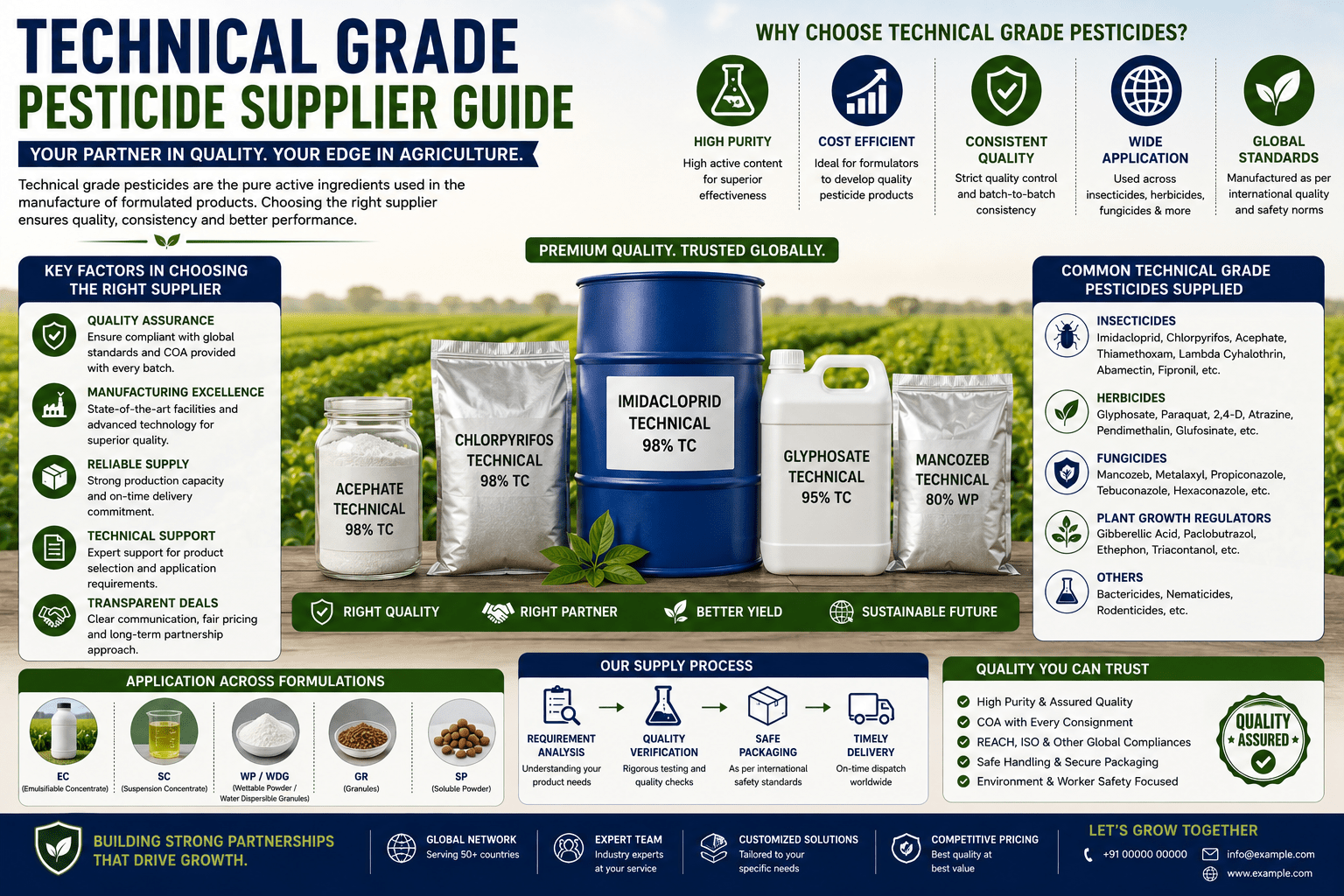
Technical grade pesticides are the purified active ingredient forms used as inputs for formulated crop protection product manufacturing. Distinguished from formulated end-use products by their high active ingredient content - typically 90-99% purity - technical grade materials require specialised production facilities, rigorous quality control systems, and careful handling protocols. For any organisation engaged in pesticide formulation, institutional supply, or export, the reliability and quality of their technical grade pesticide supplier is foundational to their own product quality and supply chain performance. Understanding what to look for in a technical supplier is therefore a critical competency for procurement professionals.
Purity Specifications: The Primary Quality Parameter
The most fundamental quality parameter for any technical grade pesticide is its active ingredient purity - the percentage of the desired molecule in the bulk material. Technical purity is specified in relevant pharmacopoeial standards, FAO/WHO specifications for technical grade materials, or bilaterally agreed specifications between buyer and supplier. Purity below specification reduces the active ingredient contribution to formulated products, affecting either efficacy (if the formulated concentration is maintained by adding more technical) or concentration (if a fixed technical addition rate is used). Buyers should insist on Certificates of Analysis demonstrating purity compliance with every shipment, verified by analytical methods validated against relevant reference standards. Ratnakar India's Dahej facility as a technical grade pesticide supplier provides full analytical documentation with every technical supply.
Impurity Profiles: Beyond Simple Purity
Sophisticated technical buyers look beyond simple active ingredient purity to the full impurity profile of the technical material. Certain manufacturing-related impurities can affect formulation stability, product safety, or regulatory compliance. Some impurities are specifically regulated with maximum limits in relevant specifications. Others may interfere with the analytical methods used for quality control. Understanding and specifying acceptable impurity profiles - and selecting suppliers with the analytical capability to verify compliance - is a mark of advanced procurement practice for any organisation dependent on technical grade pesticide supplier quality.
Regulatory Compliance and Documentation
Technical grade pesticides are subject to import and use regulations in every market. In India, the CIB&RC regulates technical imports and domestic supply. Export markets have their own registration and specification requirements. Reliable suppliers maintain the regulatory documentation required for supply in their target markets - registration certificates, import/export licences, safety data sheets (SDS), transport classification documents, and country-specific regulatory compliance letters. Buyers should verify that suppliers have the correct regulatory status for their intended use and market, and that documentation is current and complete. This regulatory competence is a key differentiator for professional agrochemical manufacturer Gujarat operations.
Analytical Capability: In-House vs Third Party
The reliability of quality data provided by a technical supplier depends critically on the analytical capability behind it. Suppliers with in-house analytical laboratories equipped with HPLC, GC-MS, and other relevant instruments, and operating validated analytical methods, provide more reliable and timely quality data than those dependent on outsourced third-party testing. In-house capability allows faster turnaround on Certificate of Analysis issuance, enables real-time process monitoring during production, and facilitates faster investigation and resolution of quality discrepancies. When evaluating a bulk pesticide supplier Gujarat, assessing analytical laboratory capability is an important part of the supplier qualification process.
Long-Term Supply Partnership
The best technical grade supply relationships are long-term partnerships based on mutual commitment to quality, transparency, and continuous improvement. Suppliers who invest in understanding their customers' technical requirements, communicate proactively on supply and quality issues, and collaborate on process improvements that benefit both parties deliver far more value than transactional commodity suppliers. Ratnakar India approaches its technical supply relationships with this partnership philosophy - building the trust and technical alignment that enables customers to rely on consistent, quality-certified technical actives season after season.
- Active ingredient purity (90-99%) is the primary technical specification - always require CoA verification with every shipment.
- Impurity profiles matter beyond simple purity - specify and verify compliance with manufacturing-related impurity limits.
- Regulatory compliance documentation - CIB&RC registration, SDS, import licences - must be current and complete for every supply.
- In-house analytical capability with validated methods provides more reliable and timely quality data than outsourced testing.
- Supplier production scale and inventory management determine supply reliability for consistent production planning.
- Long-term partnership orientation in technical supply relationships delivers better value than purely transactional procurement approaches.