
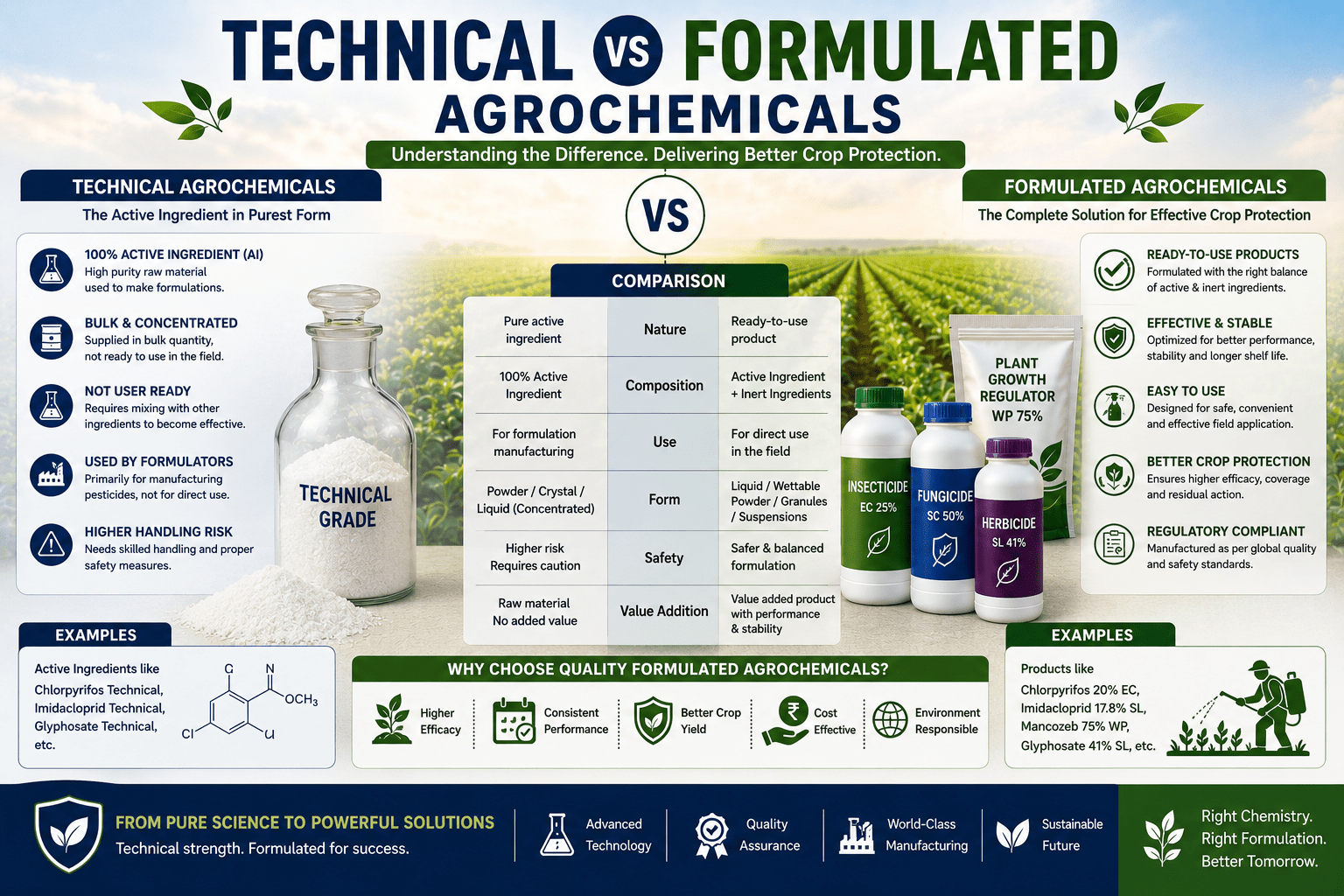
Defining Technical Grade Agrochemicals
Technical grade agrochemicals are highly pure forms of the active ingredient - the molecule that provides the pesticidal, fungicidal, herbicidal, or growth-regulating effect. Technical actives are typically produced in dedicated chemical synthesis facilities through multi-step organic chemical reactions, followed by purification processes (distillation, crystallisation, recrystallisation) to achieve the required purity levels - typically 90% or above, with many technical actives specified at 95-99% purity. Technical grade materials are not intended for direct use by farmers - they require further processing into formulated end-use products. Ratnakar India's Dahej manufacturing facility produces a range of technical grade actives as a technical grade pesticide supplier to institutional and formulation buyers.
The Role of Technical Actives in the Supply Chain
Technical actives occupy a fundamental position in the agrochemical supply chain. They are the building blocks from which all formulated crop protection products are made. The quality, purity, and consistency of the technical active directly determines the quality, efficacy, and safety of every formulated product produced from it. This is why technical grade quality assurance is so critical - and why leading manufacturers who produce their own technical actives gain a significant quality advantage over those who purchase technical materials from external, potentially variable sources. Companies acting as bulk pesticide suppliers Gujarat rely on consistent quality technical actives as the foundation of their business.
What are Formulated Agrochemicals?
Formulated agrochemicals are the ready-to-use products that farmers actually apply to their crops. They consist of the technical active ingredient combined with a carefully designed mixture of carriers, solvents, surfactants, stabilisers, and other additives that convert the pure active into a practical, safe, and effective product. Formulated products are designed for specific application methods - foliar spray, soil application, seed treatment, or granule broadcast - and optimised to deliver the active ingredient to the target pest or crop site in the most effective way possible. As an agrochemical formulation company, Ratnakar India produces hundreds of formulated products across all crop protection categories.
Key Differences in Production and Handling
Technical and formulated agrochemicals differ significantly in their production processes, handling requirements, and end uses. Technical production requires sophisticated organic chemistry facilities with reactors, distillation columns, and analytical laboratories for purity verification. Formulation production requires mixing, milling, granulation, or encapsulation equipment along with physical and biological testing capabilities. Technical actives are typically highly concentrated, requiring special handling for safety, and are supplied in bulk (drums, IBCs, tankers). Formulated products are designed for safe handling and are packaged in consumer-appropriate sizes. Both categories demand rigorous quality management from any responsible agrochemical manufacturer Gujarat operation.
Who Buys Technical vs Formulated Products?
Technical grade agrochemicals are purchased by formulation companies that use them as inputs for their product manufacturing, institutional buyers (government agencies, large agricultural programs) who may have their own formulation capabilities, and export buyers in markets with specific local formulation requirements. Formulated agrochemicals are purchased by distributors and retailers for resale to farmers, agricultural cooperatives for collective purchase programs, and institutional buyers for crop protection programs. Ratnakar India serves both segments - supplying technical actives from its Dahej facility to bulk pesticide supplier Gujarat customers, and providing formulated products to domestic and international distribution channels.
Integrated Capability: The Competitive Advantage
Companies that possess both technical manufacturing and formulation capabilities - like Ratnakar India - have a significant competitive advantage. They control quality from the ground up, maintain full supply chain visibility, can respond flexibly to market needs by adjusting the balance between technical sales and formulated product output, and can provide customers with complete traceability from synthesis to finished product. This integrated capability is increasingly valued by sophisticated buyers who need supply chain assurance as well as product quality.
- Technical actives are highly pure (90-99%) active ingredients used as inputs for formulated product manufacturing.
- Technical quality directly determines formulated product quality - making technical grade consistency a fundamental supply chain requirement.
- Formulated products combine technical actives with carriers and adjuvants for safe, effective farm-level application.
- Technical and formulated products serve different customer segments with distinct handling, packaging, and quality requirements.
- Integrated manufacturers with both technical and formulation capability have superior quality control and supply chain advantages.
- Understanding the distinction helps buyers make informed sourcing decisions and evaluate supplier capabilities accurately.