
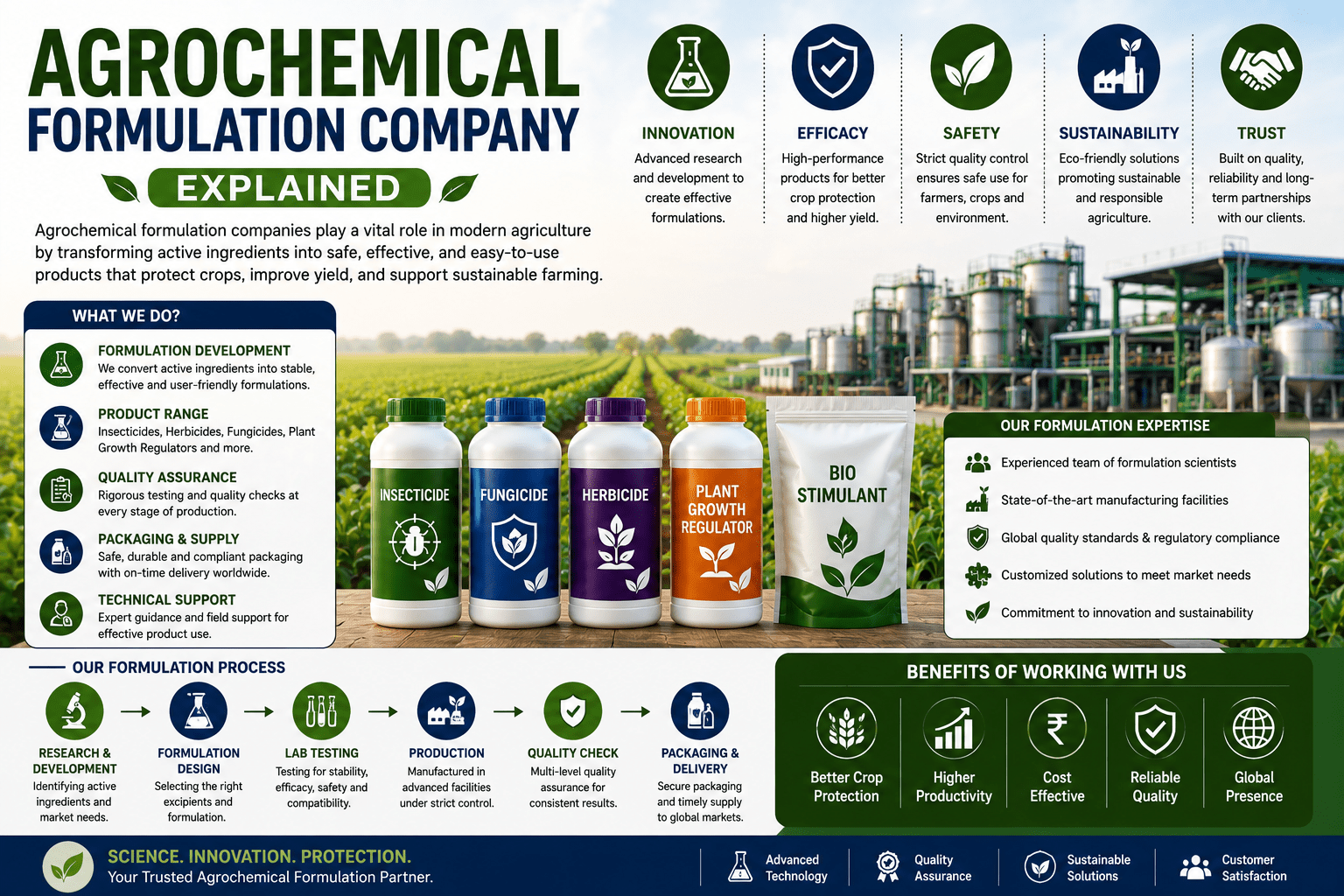
What is Agrochemical Formulation?
Agrochemical formulation is the science and technology of converting a pure active ingredient (the technical grade molecule that provides pesticidal activity) into a practical product that can be safely and effectively applied to crops. A raw technical active ingredient is typically difficult to handle, unstable in field conditions, and impossible to apply uniformly at the very low concentrations needed for effective pest control. Formulation solves these problems by combining the active ingredient with carriers, solvents, surfactants, stabilisers, and other additives to create a product that can be easily measured, mixed with water, and applied uniformly as a spray, granule, dust, or seed treatment. Every product from an agrochemical formulation company like Ratnakar India represents the application of this formulation science to a specific pest management need.
Major Formulation Types and Their Applications
The agrochemical industry has developed numerous formulation types, each suited to specific active ingredients, application methods, and use environments. Emulsifiable Concentrates (EC) are liquid concentrates that emulsify in water for spray application - one of the most common and versatile formulation types. Suspension Concentrates (SC) suspend finely milled solid active ingredients in water-based carriers for improved stability and reduced solvent content. Wettable Powders (WP) and Water Dispersible Granules (WG) are dry formulations that disperse in water for spray application, offering ease of handling. Granules (GR) are solid formulations for soil application, while Capsule Suspensions (CS) and Zeta Capsule Suspensions (ZC) provide controlled release of active ingredients for extended residual activity. Ratnakar India's portfolio spans all these formulation types as a technically sophisticated crop protection products manufacturer.
The Science of Formulation Development
Developing an effective agrochemical formulation is a rigorous scientific process. Formulation scientists first characterise the physicochemical properties of the active ingredient - solubility, melting point, stability at different pH and temperatures, compatibility with common adjuvants. They then screen potential formulation systems - evaluating different carrier types, surfactant combinations, and stabiliser packages - to identify formulations that provide good physical stability (no separation or crystallisation on storage), optimal biological efficacy (correct droplet size, good leaf coverage, appropriate penetration), and acceptable safety profile (low mammalian toxicity, acceptable environmental profile). This investment in formulation science by leading insecticide manufacturers & suppliers is what differentiates quality products from commodity imitations.
Quality Control in Formulation Manufacturing
Once a formulation is developed, manufacturing quality control ensures that every batch produced meets the defined specifications. Key quality parameters for formulated agrochemicals include active ingredient content (within specified limits), physical properties (pH, viscosity, density, particle size for suspensions), stability on storage (no significant degradation under defined conditions), biological performance in bioassay testing, and packaging integrity. Ratnakar India's quality management system encompasses all these parameters, with in-house analytical laboratories providing independent verification of every batch before release. This comprehensive quality control is the foundation of reliability for buyers who depend on consistent product performance.
Innovation in Formulation: Advanced Delivery Systems
Leading agrochemical formulation companies continuously innovate in formulation technology to improve product performance, safety, and convenience. Microencapsulation technology (CS, ZC formulations) provides controlled release of active ingredients, extending residual activity, improving rain fastness, and reducing dermal exposure risk. Nano-formulations are being developed to improve penetration and distribution within plant tissue. Combination formulations synergistically combining two or more active ingredients in a single product provide broader spectrum control and resistance management benefits. These innovation investments by companies like Ratnakar India create genuine value for farmers through improved efficacy, safety, and convenience as a progressive agrochemical manufacturer Gujarat.
- Formulation converts raw technical actives into practical, safe, and effective crop protection products suitable for farm application.
- Multiple formulation types (EC, SC, WG, GR, CS, ZC) are suited to specific active ingredients, applications, and use environments.
- Rigorous formulation development science ensures stability, efficacy, and safety in every product across diverse field conditions.
- Quality control of all physical, chemical, and biological parameters ensures consistent batch-to-batch product performance.
- Advanced delivery systems like microencapsulation extend residual activity, improve rain fastness, and enhance user safety.
- Combination formulations provide broader spectrum control and resistance management benefits in a single convenient product.