
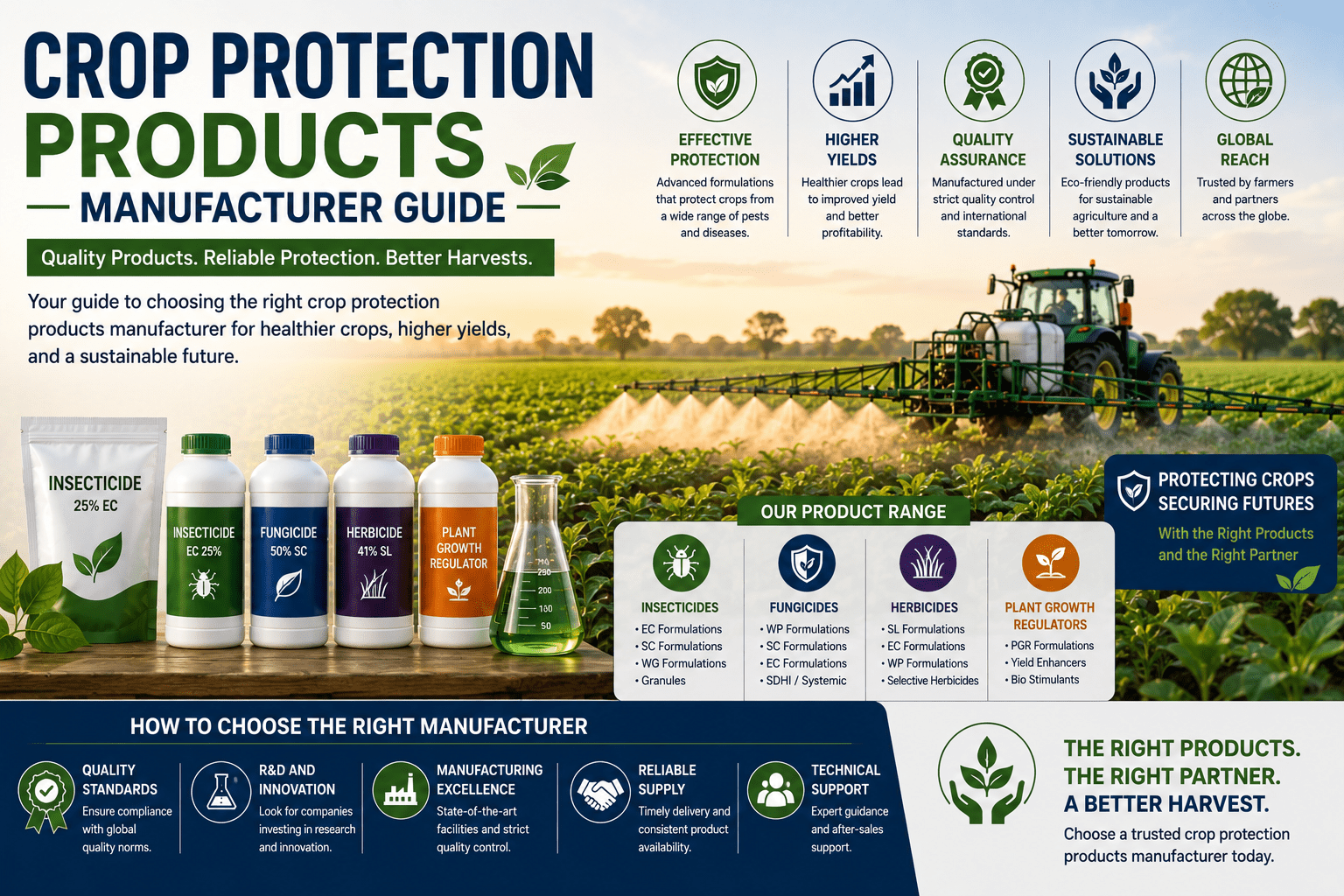
What is a Crop Protection Products Manufacturer?
A crop protection products manufacturer is a company engaged in the development, production, and marketing of chemical or biological products used to protect crops from pests, diseases, and weeds. The category encompasses a broad range of companies - from large multinational corporations with global R&D programs to specialised regional manufacturers focusing on specific product categories or markets. In India, the crop protection manufacturing sector comprises hundreds of companies spanning this entire spectrum, with Gujarat being home to a significant concentration of quality manufacturers. Ratnakar India Ltd is a prime example of an integrated Indian crop protection products manufacturer serving both domestic and international markets.
The Manufacturing Process: From Active Ingredient to Farmer
Understanding the manufacturing process helps buyers appreciate the complexity and quality requirements of crop protection production. The journey from chemical synthesis to farm application involves multiple steps: technical active ingredient production (synthesis and purification), formulation development (testing of carrier systems, adjuvants, and stabilisers), formulation manufacturing (mixing, milling, granulation, or emulsification as appropriate), quality control testing, packaging, labelling, and distribution. Each step requires specialised equipment, technical expertise, and rigorous quality management. As an agrochemical manufacturer Gujarat, Ratnakar India manages all these steps with an integrated approach that ensures quality at every stage.
Key Capabilities to Look For
When evaluating a crop protection products manufacturer, several capabilities are critical indicators of quality and reliability. Technical manufacturing capability - owning active ingredient synthesis rather than simply buying from external sources - provides quality control from the ground up. Formulation expertise - the ability to develop and produce diverse formulation types (EC, SC, WG, WP, GR, CS, ZC, etc.) - indicates manufacturing sophistication. Analytical laboratory capability - in-house HPLC, GC-MS, and other instruments - ensures independent quality verification. And regulatory expertise - knowledge of registration requirements across domestic and target export markets - demonstrates market access capability. All these capabilities are present at Ratnakar India's operations as a full-service insecticide manufacturer & supplier.
Quality Management Systems
A reliable crop protection manufacturer operates under a structured quality management system that documents processes, controls inputs and outputs, and enables traceability of every product batch. ISO 9001 provides the framework for quality management systems in manufacturing. GMP guidelines specific to agrochemical production provide additional process-specific requirements. HACCP principles adapted for chemical manufacturing help identify and control critical quality control points. Buyers should request quality system documentation, audit reports, and batch records as part of their supplier qualification process when selecting any technical grade pesticide supplier.
Environmental and Safety Standards
Responsible crop protection manufacturers operate with rigorous environmental and safety management systems. Compliance with effluent treatment requirements, air emission standards, hazardous waste management regulations, and occupational health and safety standards are non-negotiable for sustainable manufacturing operations. Environmental compliance is not just a regulatory requirement - it is a reflection of a company's commitment to operating responsibly and sustainably. Buyers who source from manufacturers with strong environmental records reduce their own ESG (Environmental, Social, Governance) risk exposure, an increasingly important consideration for international buyers and institutional procurement programs.
Choosing the Right Manufacturing Partner
Selecting the right crop protection products manufacturer as a supply partner is a strategic decision that should be based on comprehensive evaluation. Beyond price and product specification, buyers should assess quality system maturity, supply reliability track record, technical support capability, regulatory knowledge, and alignment of business values. A manufacturer who invests in the relationship - providing proactive communication, technical support, and continuous quality improvement - delivers far more value over time than a commodity supplier offering the lowest possible price. Ratnakar India's approach as an agrochemical formulation company is built on exactly this partnership philosophy.
- Integrated manufacturers - owning both technical synthesis and formulation - offer superior quality control throughout the supply chain.
- Diverse formulation capability (EC, SC, WG, CS, ZC) indicates manufacturing sophistication and product development expertise.
- In-house analytical laboratories with HPLC and GC-MS instruments ensure independent, rigorous quality verification of all products.
- ISO 9001 and GMP certification provide structured quality management system assurance for consistent production quality.
- Environmental compliance and safety systems reflect responsible manufacturing values and reduce buyer ESG risk exposure.
- Partnership-oriented manufacturers add value through technical support, regulatory assistance, and proactive communication.