
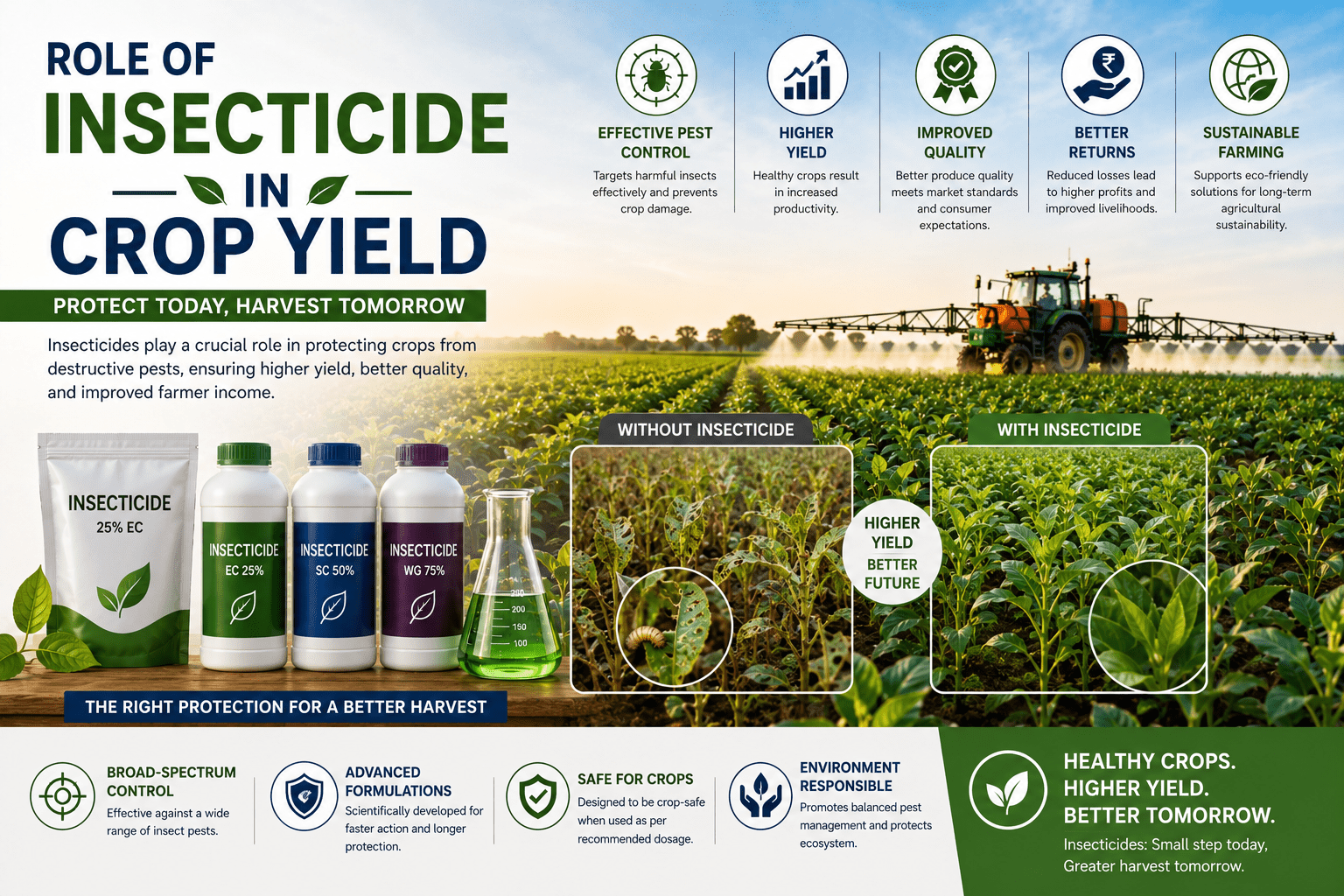
Understanding Crop Yield Losses from Insect Pests
Insect pests represent one of the most significant threats to crop yield globally. From bollworms devastating cotton fields to stem borers destroying rice crops, from aphids transmitting viruses in vegetable production to pod borers reducing pulse yields - insect pest damage operates across every crop system and every agricultural region. Without effective insect pest management, yield losses range from 10-15% in moderately infested situations to 50-80% or more in severe outbreak conditions. The economic and food security consequences of these losses are profound, making effective insecticide use a fundamental requirement of productive modern agriculture. Every insecticide manufacturer & supplier contributes to preventing these losses through the development and supply of effective crop protection tools.
How Insecticides Protect Yield Potential
Insecticides protect crop yield potential by controlling insect pest populations before they cause economically significant damage. The concept of Economic Threshold Level (ETL) - the pest population density at which the cost of control is justified by the value of the yield saved - guides effective insecticide use. When pest populations are monitored and insecticides are applied at the right time, they protect the crop's yield potential most efficiently and economically. Products from crop protection products manufacturers like Ratnakar India are formulated specifically for rapid knockdown and residual protection, ensuring pest populations are controlled effectively during critical crop growth stages.
Critical Crop Stages Requiring Protection
Different crops have different stages of maximum vulnerability to insect pest damage. In cotton, the bud and boll formation stages are critical - bollworm attack during these periods directly reduces harvestable cotton fibre. In rice, the tillering and heading stages are most vulnerable - stem borers causing dead hearts during tillering or white ears during heading can devastate yields. In grain legumes, pod borers attacking during flowering and pod fill directly reduce seed set and pod weight. Ratnakar India's product range is specifically designed to provide protection at these critical stages, with products tailored to the specific pest complexes affecting each major crop in India.
Direct vs Indirect Yield Protection
Insecticides protect yield through both direct and indirect mechanisms. Direct protection involves killing or repelling insect pests that feed on, bore into, or otherwise physically damage crop plants. Indirect protection - particularly important for vector-borne diseases - involves controlling insect vectors (aphids, whiteflies, leafhoppers) that transmit damaging viral diseases. In many vegetable and some field crops, virus disease transmitted by sucking insects can cause more yield loss than the direct feeding damage of the insects themselves. Systemic agrochemical formulation company products specifically targeting vector insects provide this indirect yield protection that is often underappreciated but critically important.
The Economics of Insecticide Investment
For farmers, insecticide investment is evaluated through the lens of return on investment. A typical insecticide application in cotton, for example, might cost Rs 500-1000 per acre in product and application costs. If that application prevents bollworm damage saving 100-200 kg of cotton per acre - worth Rs 5,000-10,000 at current prices - the return on investment is 5-20 times the cost. This economics of crop protection investment is fundamental to understanding why farmers choose and trust reliable insecticide manufacturers & suppliers that deliver consistent efficacy, even when cheaper, less reliable alternatives are available.
Integrated Pest Management: Maximising Yield Protection Sustainably
Responsible insecticide use as part of an Integrated Pest Management (IPM) program maximises crop yield protection while minimising environmental impact and resistance development. IPM combines regular pest monitoring, use of economic thresholds, rotation of chemical classes, integration with biological controls, and adoption of resistant crop varieties. Ratnakar India supports IPM by offering a diverse portfolio of insecticides across multiple chemical classes, enabling effective resistance management rotation, and providing technical guidance to farmers on optimal pest management practices for sustainable yield protection.
- Insect pests can cause 10-80% crop yield losses without effective management - insecticides are essential for yield protection.
- Application at Economic Threshold Levels ensures cost-effective, timely pest management that maximises yield protection investment.
- Critical crop stages - bud/boll formation in cotton, tillering in rice, pod fill in legumes - require targeted insecticide protection.
- Indirect yield protection through vector control prevents insect-transmitted viral diseases that cause major crop losses.
- Insecticide investment typically returns 5-20 times the cost in protected crop value, demonstrating strong farmer ROI.
- IPM integration with insecticide use maximises long-term yield protection sustainability and resistance management.