
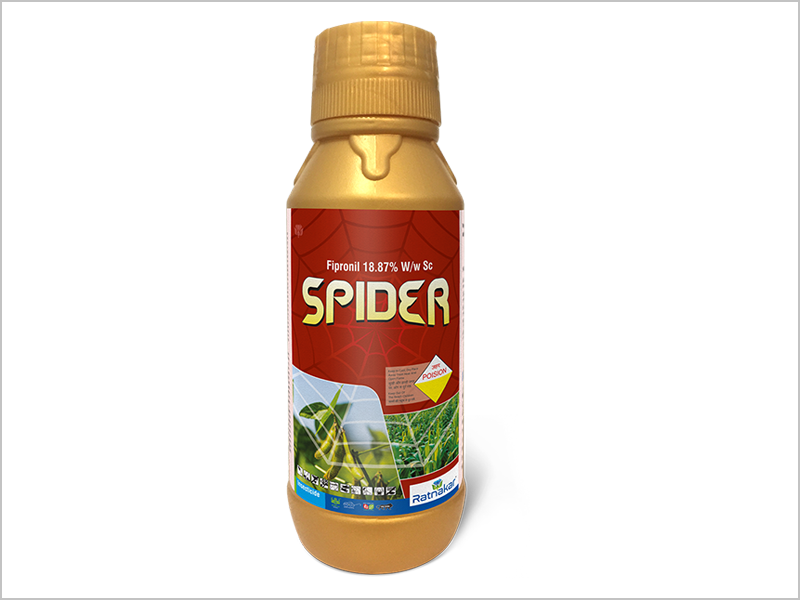
SPIDER
Fipronil 18.87% SC
SPIDER (Fipronil 18.87% SC) is a specialised high-concentration Fipronil insecticide from Ratnakar India Ltd, Ahmedabad - India's trusted agrochemical manufacturer, supplier, and exporter - designed specifically for thrips control in cotton. Thrips are difficult to manage due to their small size and feeding in protected plant locations. SPIDER's concentrated Fipronil formulation provides systemic and contact action to reach thrips in cotton buds and young leaves. Fipronil blocks GABA-gated chloride channels for rapid thrips knockdown. Manufactured and exported by Ratnakar India from Gujarat, SPIDER is a specialised, effective tool for cotton farmers dealing with thrips causing significant yield losses and quality reduction.
| Mode of Action | Systemic action | |
|---|---|---|
| Recommended Crops | Target Pest | Dose/Acre |
| Cotton | Thrips | 150 ml |
| Chilli | Thrips, Aphids, Helicoverpa armigera | 100 ml |
| Rice | Stem Borer, Leaf Folder , Brown Plant Hopper | 100 ml |
| Packing | 100 ml, 250 ml, 500 ml, 1 ltr. | |
FAQ for SPIDER
Why is SPIDER specifically formulated for thrips in cotton?
Thrips are tiny pests feeding in protected locations inside cotton buds. SPIDER's high-concentration Fipronil with systemic activity ensures effective penetration to reach hidden thrips populations.
How does SPIDER control hidden thrips infestations?
Fipronil in SPIDER has both contact and systemic activity, allowing it to reach thrips feeding inside cotton buds and young leaves where conventional contact-only insecticides may not penetrate.
What is the concentration advantage of SPIDER (18.87% SC)?
SPIDER's higher Fipronil concentration (18.87% SC) provides enhanced efficacy against thrips compared to standard 5% SC Fipronil formulations at the recommended label application doses.
When should SPIDER be applied for thrips control in cotton?
Apply SPIDER at first sign of thrips infestation, particularly when damage is observed on young cotton leaves and buds during early vegetative and squaring stages of crop development.
Can SPIDER also control other pests in cotton?
Yes, Fipronil in SPIDER has broad-spectrum activity and can also control other susceptible insects in cotton alongside the primary target pest thrips at recommended label doses.