
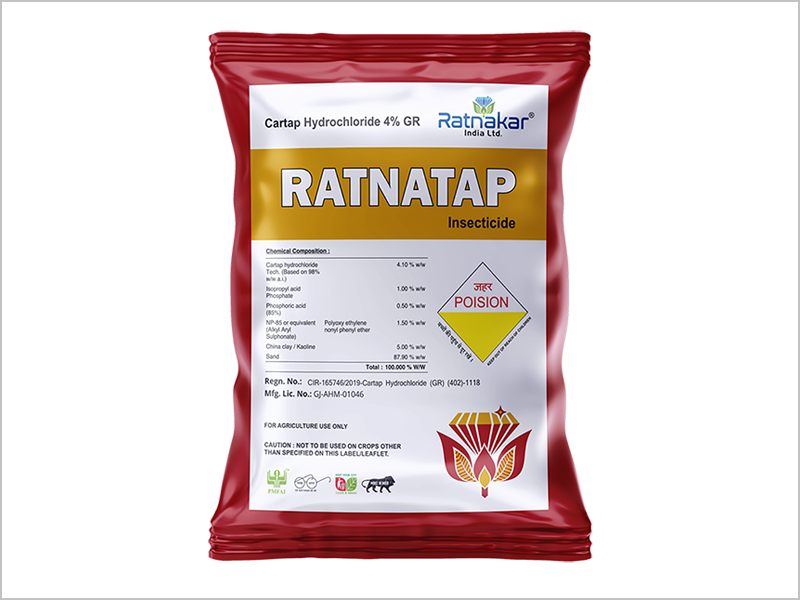
RATNATAP
Cartap Hydrochloride 4% GR
RATNATAP (Cartap Hydrochloride 4% GR) is a systemic granular insecticide from Ratnakar India Ltd, Ahmedabad - India's leading agrochemical manufacturer, supplier, and exporter - providing effective control of leaf folders, stem borers, and whorl maggots in rice through stomach and contact action. Cartap Hydrochloride mimics nereistoxin to block nicotinic acetylcholine receptors. RATNATAP granules broadcast in paddy fields dissolve in standing water for root uptake and systemic plant distribution. Manufactured and exported by Ratnakar India from Gujarat, RATNATAP is a trusted convenient rice insecticide providing labour-saving granular application for effective paddy pest management.
| Mode of Action | Systemic, Stomach And Contact action | |
|---|---|---|
| Recommended Crops | Target Pest | Dose/Acre |
| Rice | Stem bore, Leaf folder, Whorl maggot | 7.5 – 10 kg |
| Packing | 100 gm, 250 gm, 500 gm, 1 kg | |
FAQ for RATNATAP
How is RATNATAP applied in rice?
RATNATAP granules are broadcast by hand or mechanically into flooded paddy fields. Granules dissolve in standing water releasing Cartap Hydrochloride for root uptake and systemic distribution throughout rice plants.
What pests does RATNATAP control?
RATNATAP controls leaf folders (Cnaphalocrocis medinalis), stem borers (Scirpophaga incertulas), and whorl maggots - three key insect pests responsible for significant rice yield losses across India.
What are the advantages of granular formulation in RATNATAP?
Granular formulation enables easy broadcast without spray equipment, reduces applicator exposure, provides precise slow release of Cartap Hydrochloride, and is ideal for flooded paddy field applications.
How does Cartap Hydrochloride work?
Cartap Hydrochloride is a nereistoxin analogue blocking insect nicotinic acetylcholine receptors, causing disruption of nerve impulse transmission, rapid paralysis, and death of target pest insects.
At what stage should RATNATAP be applied?
Apply RATNATAP at active tillering stage (15–25 DAT) for stem borer and leaf folder control. Maintain standing water for at least 5–7 days after application for best systemic uptake results.