
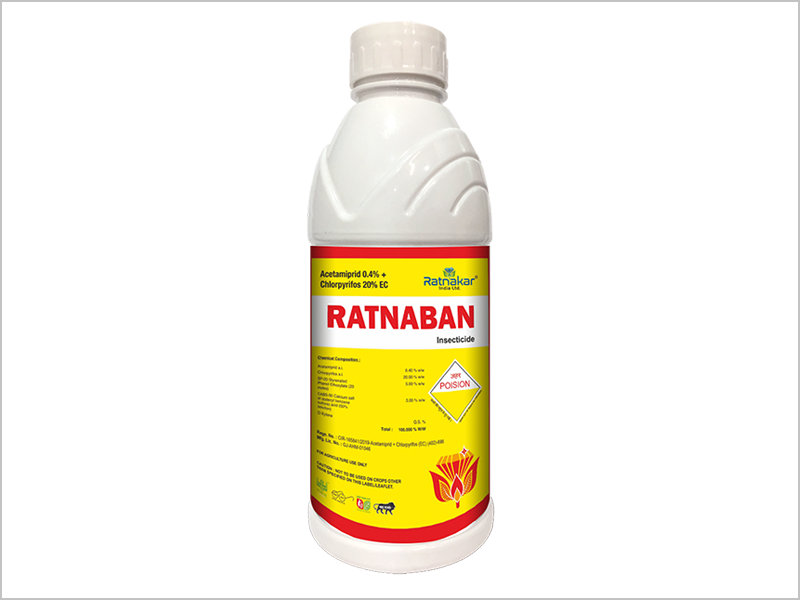
RATNABAN
Acetamiprid 0.4% + Chlorpyriphos 20% EC
RATNABAN (Acetamiprid 0.4% + Chlorpyriphos 20% EC) is an effective combination insecticide from Ratnakar India Ltd, Ahmedabad - India's trusted agrochemical manufacturer, supplier, and exporter. The combination of Acetamiprid (neonicotinoid, systemic) and Chlorpyriphos (organophosphate, contact) provides dual-mode action against stem borers, BPH, and WBPH in rice. RATNABAN covers both chewing and sucking pest complexes comprehensively. Available in large 5-litre and 20-litre packs for commercial farming convenience. Manufactured and exported by Ratnakar India from Gujarat, RATNABAN is a trusted, cost-effective agrochemical for rice farmers across India seeking reliable broad-spectrum paddy pest control.
| Mode of Action | Systemic and contact action | |
|---|---|---|
| Recommended Crops | Target Pest | Dose/Acre |
| Rice | Stem Borer, Brown plant hopper & White backed plant hopper | 1 gm/acer |
| Packing | 100 ml, 250 ml, 500 ml, 1 ltr, 5 Ltr, 20 Ltr. | |
FAQ for RATNABAN
What pests does RATNABAN control in rice?
RATNABAN controls stem borers, Brown Plant Hoppers (BPH), and White Backed Plant Hoppers (WBPH) in rice through its combined systemic neonicotinoid and contact organophosphate action.
How does the combination in RATNABAN work?
Acetamiprid provides systemic neonicotinoid action against sucking pests (plant hoppers), while Chlorpyriphos adds contact organophosphate activity targeting stem borers and other chewing rice insects.
Is RATNABAN available in large pack sizes?
Yes, RATNABAN is available in 5-litre and 20-litre packs in addition to smaller sizes, making it convenient and highly economical for large-scale commercial rice farming operations.
When should RATNABAN be applied in rice?
Apply RATNABAN at first appearance of stem borer damage (dead heart) or when plant hopper populations exceed economic threshold levels during the active vegetative or reproductive rice growing stage.
Can RATNABAN be used in both kharif and rabi rice?
Yes, RATNABAN can be used in both kharif (monsoon) and rabi (winter) rice seasons whenever target pest infestations exceed established economic threshold levels requiring chemical intervention.