
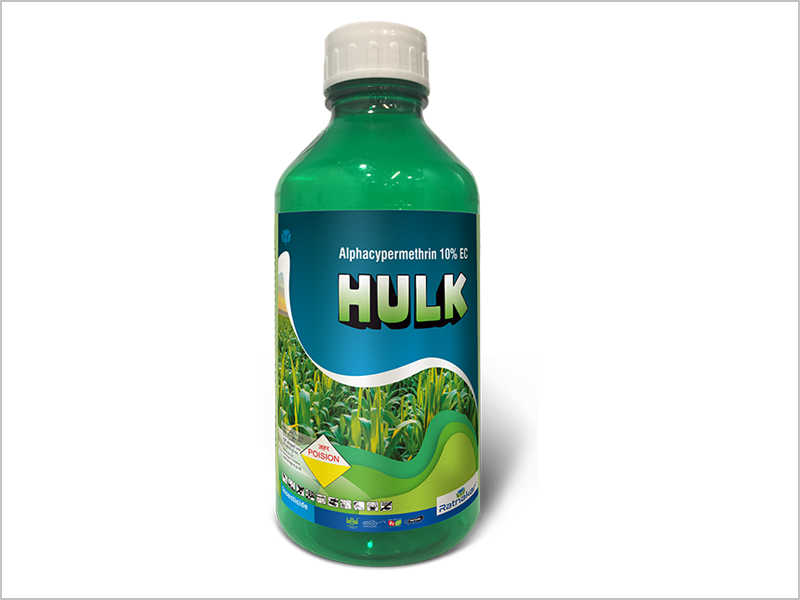
HULK
Alphacypermethrin 10% EC
HULK (Alphacypermethrin 10% EC) is a powerful synthetic pyrethroid insecticide from Ratnakar India Ltd, Ahmedabad - a leading agrochemical manufacturer, supplier, and exporter in India. Alphacypermethrin is a refined alpha-isomer of Cypermethrin with enhanced potency at lower doses, delivering rapid knockdown and reliable bollworm control in cotton through contact and stomach action. HULK's superior efficacy at low application rates makes it an economical choice for cotton farmers. Manufactured and exported by Ratnakar India from Gujarat, HULK is a trusted agrochemical brand delivering high-performance bollworm management across cotton-growing regions in India and international export markets.
| Mode of Action | Contact and Stomach action | |
|---|---|---|
| Recommended Crops | Target Pest | Dose/Acre |
| Cotton | Bollworm | 100-120 ml |
| Packing | 100 ml, 250 ml, 500 ml, 1 ltr. | |
FAQ for HULK
How is Alphacypermethrin in HULK different from regular Cypermethrin?
Alphacypermethrin is a purified alpha-isomer of Cypermethrin with higher insecticidal potency, requiring lower application rates while providing equivalent or superior efficacy compared to standard Cypermethrin formulations.
Which bollworms does HULK control?
HULK controls American bollworm (Helicoverpa armigera), spotted bollworm (Earias vitella), and pink bollworm (Pectinophora gossypiella) in cotton through rapid contact and stomach pyrethroid action.
What is the recommended dose of HULK?
HULK is typically used at 0.75–1 ml per litre of water. Alphacypermethrin's higher potency means lower doses than standard Cypermethrin are needed for effective and reliable pest control.
Can HULK be used in combination with other insecticides?
Yes, HULK can be combined with other insecticides for broader spectrum control. Always conduct a jar compatibility test and follow Ratnakar India label recommendations before tank mixing.
Does HULK have repellent properties?
Like other pyrethroids, Alphacypermethrin in HULK has repellent activity in addition to contact kill effect, helping reduce pest feeding damage even before direct pest-insecticide contact occurs.